
Jazz has been part of Canada’s musical identity since the swing orchestras and lively clubs of the early twentieth century. Rooted in blues, improvisation, and African American traditions, it took hold in Canadian cities, where musicians brought fresh ideas to performance and composition.
Today, Canadian jazz spans bebop, cool jazz, vocal jazz, fusion, smooth jazz, and Caribbean-influenced styles. Its artists have built international careers and won over new generations of listeners.
From legendary instrumentalists to contemporary innovators, these 20 artists have shaped the sound of Canadian jazz.
What Makes a Jazz Artist Influential?
In jazz, influence can’t be measured by awards or sales alone. Jazz musicians leave their mark in different ways, from developing original playing techniques and compositions to introducing fresh ensemble arrangements and reaching wider audiences.
Improvisation plays a central role in jazz, allowing performers to give familiar melodies a fresh interpretation, exchange musical ideas, and make each live performance unique.
Skill matters, but so do imagination, phrasing, arranging, and collaboration.
Canadian jazz grew through clubs, radio, touring orchestras, festivals, and music education, with Montreal, Toronto, and Vancouver leading the way. That tradition lives on in Toronto today, from intimate instrumental sets to contemporary jazz arrangements for live audiences.
20 Canadian Jazz Artists Across the Decades
Canada has produced remarkable pianists, trumpeters, guitarists, vocalists, composers, and bandleaders. These jazz music artists demonstrate the range of musical approaches that have contributed to the country’s jazz history.
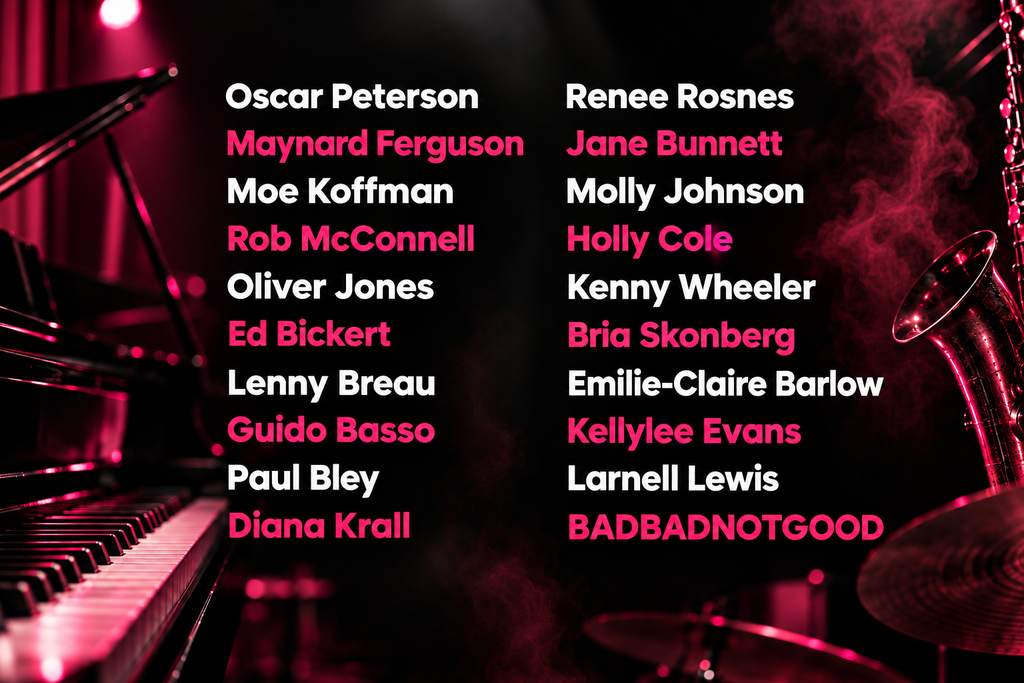
Canadian Jazz Pioneers and Foundational Artists
Let’s go over the greatest jazz artists.
1. Oscar Peterson: A Master of Jazz Piano
Montreal-born Oscar Peterson combined extraordinary technical control with a deep understanding of swing, blues, and bebop. His remarkable speed, impeccable timing, and ability to bring fresh emotion to familiar melodies established him as one of jazz’s most influential pianists.
His Canadiana Suite, recorded in 1964, drew inspiration from Canadian landscapes and locations. Through international touring, recordings, and collaborations with musicians including Ella Fitzgerald and Louis Armstrong, Peterson brought Canadian jazz musicianship to audiences worldwide.
2. Maynard Ferguson: The Power of the Trumpet
Maynard Ferguson, born in Verdun, Quebec, became famous for his extraordinary high-register trumpet playing and energetic big-band performances.
After working with Stan Kenton’s orchestra, he led ensembles that brought together jazz improvisation, powerful brass arrangements, and popular musical influences. His recording of “Gonna Fly Now” from Rocky introduced his trumpet style to a particularly broad audience. Ferguson brought together complex jazz arrangements and powerful, energetic performances that captivated live audiences.
3. Moe Koffman: Bringing Jazz to Popular Audiences
Toronto saxophonist and flautist Moe Koffman helped connect jazz with mainstream Canadian listeners.
His instrumental recording “The Swingin’ Shepherd Blues” became an international hit, while compositions such as “Curried Soul” became familiar through CBC Radio’s As It Happens. Koffman’s work crossed jazz, blues, and accessible instrumental music, showing that adventurous musicianship could reach well beyond traditional jazz clubs.
4. Rob McConnell: A Canadian Big-Band Visionary
Trombonist and arranger Rob McConnell established the Boss Brass in 1968, creating one of Canada’s most respected large jazz ensembles.
His arrangements combined rich brass harmonies, carefully structured compositions, and room for individual improvisation. The Boss Brass attracted accomplished Canadian musicians and earned recognition internationally. McConnell’s lasting contribution was demonstrating that sophisticated big-band jazz could flourish in Canada long after the swing era.
5. Oliver Jones: Montreal’s Piano Tradition
Oliver Jones grew up in Montreal’s Little Burgundy neighbourhood, where he studied piano with Daisy Peterson, Oscar Peterson’s sister.
His playing combined blues feeling, lively swing rhythms, and an expressive approach to jazz standards. After years working internationally, Jones returned to Montreal and established a successful recording and concert career. He became an important figure in Quebec jazz, connecting the city’s earlier piano traditions with new audiences.
6. Ed Bickert: The Art of Subtle Jazz Guitar
Ed Bickert was known for his subtle, thoughtful guitar playing, using inventive harmonies and a gentle touch rather than relying on flashy improvisation.
Known for his warm electric-guitar tone and inventive chord voicings, he worked extensively in Toronto and performed with American saxophonist Paul Desmond. Bickert’s understated playing demonstrated how subtle rhythmic choices and harmonic ideas could carry as much musical weight as technical display.
7. Lenny Breau: Expanding the Guitar’s Possibilities
Born in Auburn, Maine, and raised in Canada, Lenny Breau combined jazz harmony, country fingerstyle techniques, and classical influences to develop a distinctive approach to guitar playing.
His playing often incorporated independent bass lines, chords, and melodies at the same time, producing textures associated with multiple instruments. His use of harmonics and advanced fingerpicking techniques expanded the expressive possibilities of jazz guitar and continues to interest guitarists across musical genres.
8. Guido Basso: The Sound of Canadian Brass
Montreal-born Guido Basso was a highly regarded trumpeter and flugelhorn player whose warm tone became a recognizable part of Canadian jazz.
Through his extensive work in recording studios, broadcasting, and Rob McConnell’s Boss Brass, Basso remained an active presence in Canadian jazz for decades. His lyrical flugelhorn playing demonstrated the expressive possibilities of brass instruments beyond powerful big-band passages.
9. Paul Bley: A Pioneer of Free Jazz Piano
Montreal-born Paul Bley helped transform modern jazz piano through his experimental approach to harmony, improvisation, and ensemble interaction.
An important figure in the development of free jazz, Bley worked with musicians including Ornette Coleman and Jimmy Giuffre. His solo album Open, to Love, recorded in 1972, showcased his spacious, unconventional piano style and became an influential recording in modern jazz.
Artists Who Expanded Canadian Jazz Internationally
It’s time to discover the next jazz artists who became internationally popular.
10. Diana Krall: Jazz Vocals with Global Appeal
Born in Nanaimo, British Columbia, Diana Krall became internationally recognized for her understated contralto voice and accomplished piano playing.
Her renditions of jazz classics, bossa nova, and traditional pop are distinguished by thoughtful phrasing and a natural sense of rhythm. Albums including When I Look in Your Eyes and The Look of Love helped introduce vocal jazz to a substantial international audience, reinforcing the place of classic repertoire in contemporary popular music.
11. Renee Rosnes: A Leading Modern Jazz Composer
Pianist Renee Rosnes, raised in North Vancouver, established her international career after moving to New York in 1985.
Her collaborations with renowned jazz musicians Joe Henderson, Wayne Shorter, and Bobby Hutcherson helped shape her career, which later included numerous recordings for Blue Note Records. Her compositions combine intricate harmony with clear melodic direction. As founder and musical director of ARTEMIS, Rosnes has brought together leading women instrumentalists in an internationally recognized jazz ensemble.
12. Jane Bunnett: Connecting Canadian and Afro-Cuban Jazz
Toronto-born Jane Bunnett is a soprano saxophonist and flautist whose career has focused extensively on musical collaborations with Cuban artists.
Her recordings incorporate Afro-Cuban rhythms, jazz improvisation, and traditional Cuban musical influences. With her ensemble Maqueque, Bunnett has created opportunities for talented Cuban women musicians while presenting their work internationally. Her career illustrates how sustained collaboration across musical cultures can produce distinctive new jazz recordings and performances.
13. Molly Johnson: Jazz, Soul and Blues Expression
Toronto singer Molly Johnson built her career across rock, pop and soul before establishing herself as a distinctive jazz vocalist.
Her smoky voice and emotionally direct delivery are particularly well suited to blues-influenced arrangements and interpretations of classic standards. Albums such as Lucky and Because of Billie explore jazz singing through a contemporary perspective. Johnson’s career reflects the close musical relationship between jazz and other vocal traditions.
14. Holly Cole: Reimagining Familiar Songs
Nova Scotia-born Holly Cole is known for approaching familiar songs with unexpected arrangements and dramatic vocal interpretation.
Working with musicians including pianist Aaron Davis and bassist David Piltch, she developed a trio sound distinguished by spacious arrangements and unusual repertoire choices. Her versions of jazz classics, pop songs, and other musical styles feature creative arrangements that bring a fresh perspective to familiar tunes.
15. Kenny Wheeler: A Distinctive Voice in European Jazz
Toronto-born Kenny Wheeler was a trumpeter, flugelhornist, and composer who became a major figure in British and European jazz after moving to England in 1952.
Known for his lyrical tone and sophisticated compositions, Wheeler combined post-bop with free improvisation. His collaborations with musicians such as Dave Holland and John Stevens helped establish his international reputation, while recordings for ECM Records showcased his distinctive approach to jazz composition.
Contemporary Canadian Jazz Artists and New Directions
Now, let’s explore the contemporary jazz music artists.
16. Bria Skonberg: Renewing Traditional Jazz
British Columbia-born Bria Skonberg combines trumpet performance, singing, and songwriting in a style inspired by early jazz, swing, and blues.
Her music draws from classic New Orleans traditions while incorporating contemporary compositions and arrangements. Through performances, recordings, and educational initiatives, Skonberg has helped make traditional jazz engaging for audiences who may be discovering those styles for the first time.
17. Emilie-Claire Barlow: Vocal Precision and Orchestral Arrangements
Toronto vocalist Emilie-Claire Barlow is recognized for her clear articulation, rhythmic precision, and carefully arranged interpretations of jazz standards.
Her repertoire includes swing, bossa nova, and popular songs adapted for jazz ensembles. Barlow is also an accomplished arranger, with recordings that demonstrate how orchestration can reshape a familiar melody while preserving its original character.
18. Kellylee Evans: Jazz Meets Soul and R&B
Canadian vocalist Kellylee Evans brings jazz improvisation into music influenced by soul, R&B, and contemporary pop.
Her expressive vocal delivery and rhythmic flexibility allow her to move between acoustic jazz arrangements and groove-oriented performances. Her album Nina, inspired by Nina Simone’s repertoire, demonstrated her ability to reinterpret socially and emotionally significant material through her own musical perspective.
19. Larnell Lewis: Modern Jazz Drumming and Fusion
Toronto drummer Larnell Lewis is known for his extraordinary rhythmic control, complex grooves, and versatility across jazz, funk, gospel, and fusion.
His work with instrumental group Snarky Puppy, including the album We Like It Here, helped introduce his playing to an international audience. Alongside his performances and solo recordings, Lewis has become a prominent educator, showing younger musicians how technical drumming can support musical communication rather than dominate it.
20. BADBADNOTGOOD: Jazz for a New Generation
Formed in Toronto in 2010, BADBADNOTGOOD developed a distinctive sound by combining jazz improvisation with hip-hop, electronic textures, soul, and funk.
The group initially attracted attention through jazz reinterpretations of hip-hop tracks before developing an extensive catalogue of original recordings. Collaborations with Ghostface Killah and other contemporary artists helped establish a musical connection between jazz ensembles and modern production.
How Canadian Jazz Has Evolved Across the Decades
Canadian jazz has evolved from swing bands and club performances into bebop, fusion, and contemporary styles. Musicians such as Oscar Peterson and Ed Bickert gained international recognition, while Rob McConnell’s Boss Brass helped preserve Canada’s big-band tradition.
Festivals in Montreal, Toronto, and Vancouver have supported this growth, bringing Canadian and international musicians together. Classic standards, including many of the greatest jazz songs, remain central to live performances and improvisation.
Canadian jazz continues to evolve as musicians incorporate R&B, funk, hip-hop, Latin, and Caribbean rhythms into their work. Jane Bunnett’s Afro-Cuban projects and BADBADNOTGOOD’s fusion of jazz and hip-hop reflect this diversity, bringing fresh sounds to the Toronto live music scene and audiences across Canada.
Discover Jazz Artists with ONQ Live
Live jazz adds character to corporate events, weddings, and private celebrations. ONQ Live connects event planners with professional jazz music artists, from intimate ensembles to contemporary performers.
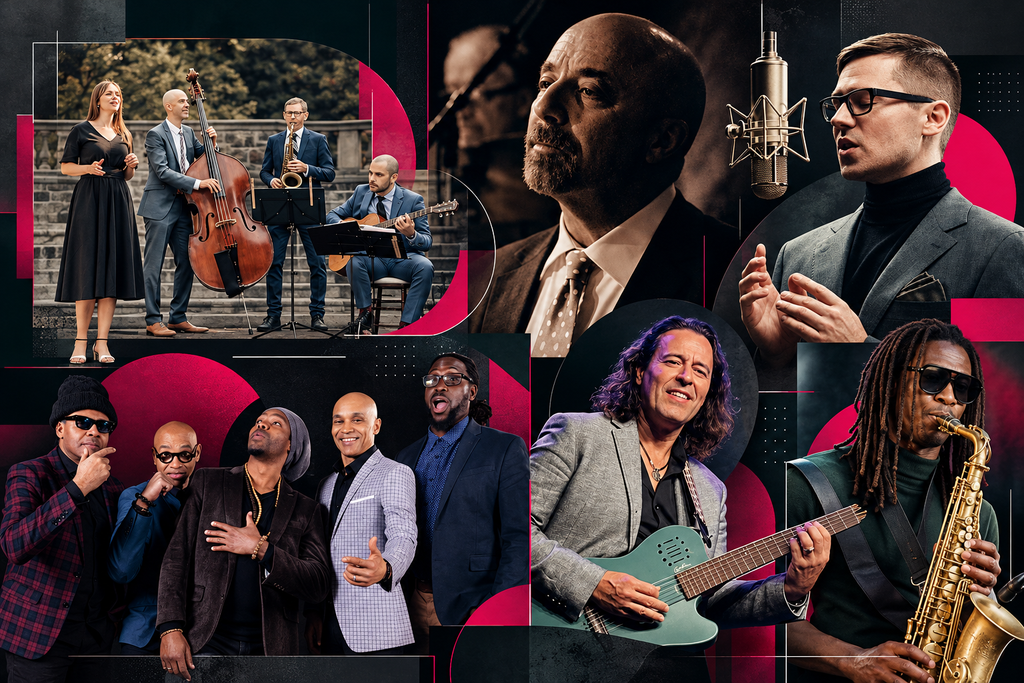
Tiffany Jazz Trio
Tiffany Jazz Trio brings timeless jazz and swing favourites to weddings, cocktail receptions, and smaller celebrations, offering an elegant musical backdrop for guests.
Steve Holt
Steve Holt is an accomplished jazz pianist known for his dynamic ensemble performances, making him a strong choice for concerts and music-focused events.
Steven Taetz
Steven Taetz blends jazz vocals, vintage pop, and swing, bringing timeless charm to formal dinners and elegant receptions.
Caribbean Jazz Collective
Caribbean Jazz Collective, led by Eddie Bullen and Joaquin Nunez Hidalgo, combines Caribbean rhythms with jazz improvisation for festivals and cultural celebrations.
Rob Tardik
Rob Tardik brings smooth-jazz guitar and contemporary fusion to upscale receptions, networking events, and modern lounge settings.
Joseph Callender
Joseph Callender brings together jazz, soul, R&B, reggae, and Afro-Caribbean sounds through his saxophone performances, making him a fitting choice for corporate gatherings and private celebrations.
Choosing the Right Jazz Performance for Your Event
The most effective jazz performance depends on the venue, audience, and role music will play throughout the event.
For smaller gatherings, duos and trios provide live music with a compact setup and flexible volume. Larger live bands can deliver fuller arrangements for galas, celebrations, and events with a dedicated entertainment program.
ONQ Live also provides Live Entertainment for corporate events, helping organizers choose music for conferences, brand activations, awards ceremonies, and business celebrations.
Whether you prefer traditional swing, sophisticated vocal jazz, or contemporary instrumental music, our team can help you explore performers who complement your event’s atmosphere and schedule.
Frequently Asked Questions
1. How far in advance should I book a jazz artist for a live event?
Booking several months ahead is advisable, especially for peak wedding dates, holiday parties, and major corporate events. Availability varies by performer, location, and event date.
2. Can a jazz band learn a specific standard or special-request song?
The greatest jazz artists can accommodate song requests, depending on their repertoire and preparation time. Share special selections before booking so the artist can confirm whether they can perform them.
3. What is the best jazz ensemble size for a cocktail reception?
A duo or trio is often a practical choice because it provides a full musical experience without requiring a large performance area. The ideal format depends on guest numbers, venue acoustics, and the desired atmosphere.
4. Can jazz musicians perform during dinner without overpowering conversation?
Yes. Small jazz ensembles are particularly well suited to dinner service. Confirm the preferred sound level, instruments, and musicians’ setup location with your entertainment provider ahead of the event.
5. Can a live jazz performance transition into a DJ or higher-energy set later in the evening?
Yes. An event can begin with jazz during cocktails or dinner and transition to a DJ or dance band later. Planning set times, sound requirements, and changeovers helps keep the entertainment running smoothly.
6. What production setup does a jazz trio or band usually need?
Requirements vary by instrumentation and venue. A trio may need microphones, amplification, power, and a suitable performance area. Bigger bands may need more extensive audio equipment, stage monitors, and on-site technical assistance.
7. Can I book a jazz artist for a corporate or private event?
Yes. ONQ Live offers jazz performers for corporate events, weddings, private celebrations and public functions. Explore our roster to book an artist or contact our team to discuss your event’s requirements.