
Caribbean music can shape an event in very different ways. Reggae might fill a reception with warm bass lines and an easygoing rhythm, while soca can bring guests onto the dance floor with infectious percussion and Carnival-inspired energy.
Although both genres originated in the Caribbean, they have distinct histories and musical identities. Reggae emerged in Jamaica, drawing on ska and rocksteady, while soca developed in Trinidad and Tobago from calypso and other musical influences.
When comparing reggae vs. soca for an event, the decision goes beyond musical preference. Consider whether guests will be socializing, enjoying a live performance, or dancing, and how the music should complement each part of the celebration.
Reggae vs. Soca at a Glance
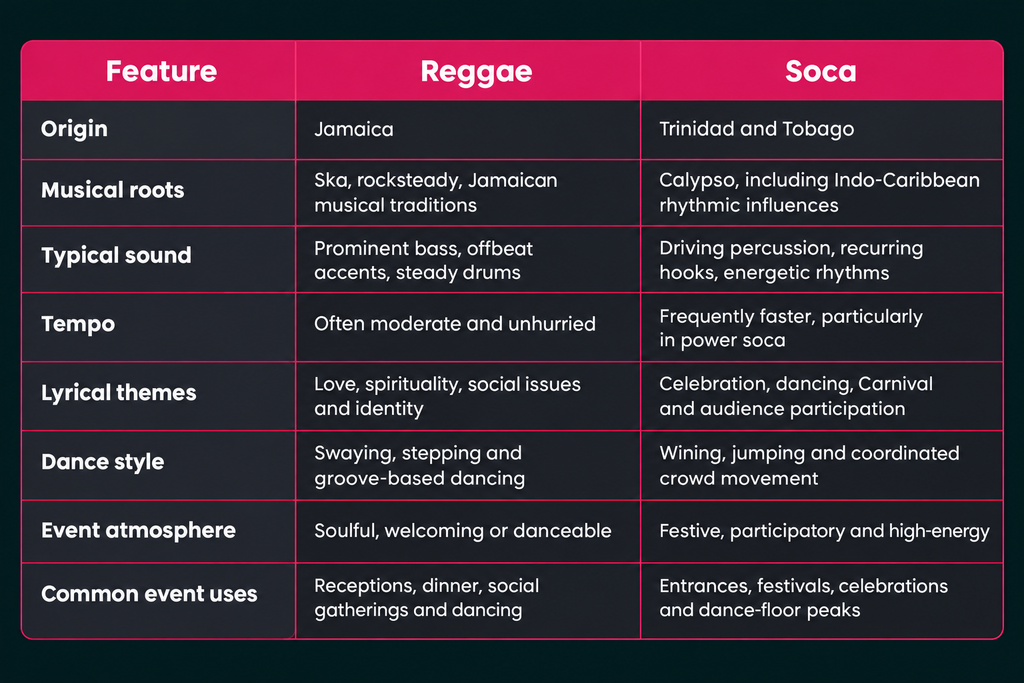
These are general tendencies rather than strict rules. Both genres have developed numerous styles, and individual songs can differ significantly in pace, subject matter, and intensity.
What is Reggae Music?
Ska and rocksteady gave rise to reggae in Jamaica in the late 1960s. Deep bass lines, steady drumming, and unusual guitar or keyboard rhythms combine to create its unique sound.
Beyond its musical style, reggae has strong cultural roots. Closely associated with Rastafari, roots reggae explores spirituality, identity, and social justice, while lovers rock focuses on romance and soulful melodies.
Artists such as Bob Marley, Peter Tosh, Burning Spear, and Toots and the Maytals helped bring reggae to international audiences.
For events, reggae offers versatility, from mellow selections for cocktail receptions and dinners to upbeat tracks that encourage dancing.
What is Soca Music?
Soca emerged in Trinidad and Tobago during the 1970s, evolving from calypso with Caribbean and international influences. Pioneer Ras Shorty I helped develop the genre by introducing Indo-Caribbean rhythms, notably in his recording “Indrani.” Later, artists such as Machel Montano brought soca to wider international audiences.
Closely connected to Trinidad and Tobago’s Carnival, soca features lively percussion, catchy choruses, and rhythms that encourage dancing. Groovy soca offers a smoother feel, while power soca delivers faster, more energetic performances.
With its festive character and emphasis on crowd participation, soca is a popular choice for weddings, festivals, and private celebrations.
The Biggest Differences Between Reggae and Soca
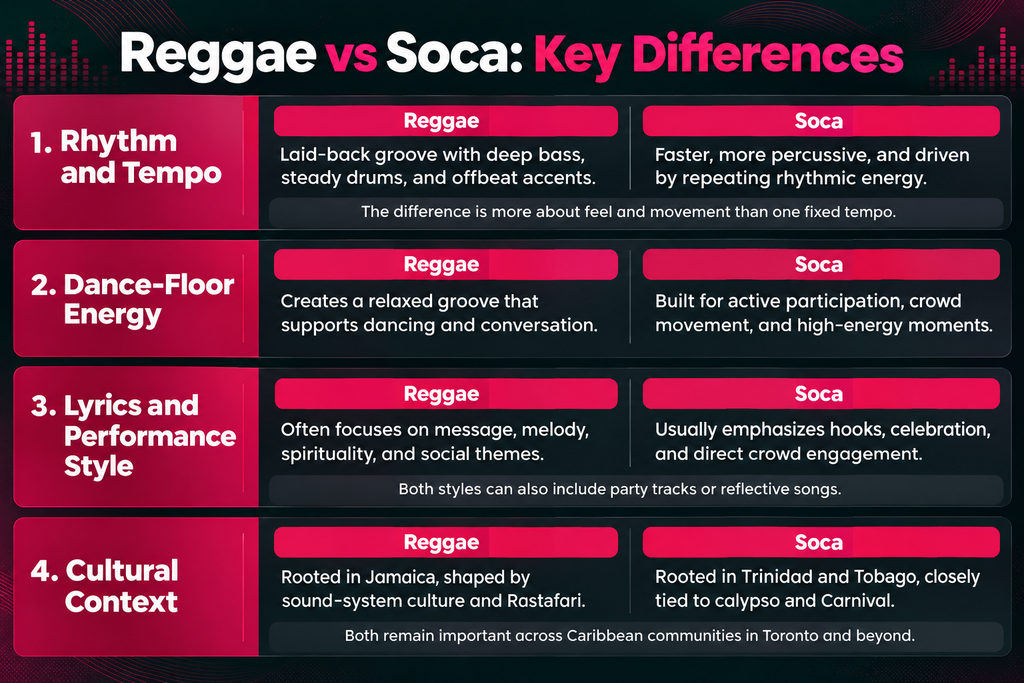
Rhythm and Tempo
Reggae generally relies on a spacious rhythmic structure, allowing bass, drums, and offbeat guitar or keyboard accents to interact. The result can feel relaxed even when the rhythm is strong.
Soca commonly uses busier percussion, a more insistent pulse, and repeating rhythmic phrases. Power soca is typically faster, although groovy soca and other variations offer different tempos.
Neither genre has one universal tempo range. Rather than the quantity of beats per minute, the arrangement’s ability to create movement is frequently the most significant difference.
Dance-Floor Energy
Reggae gives dancers room to settle into a groove, respond to the bass line, and move at their own pace. It can support an active dance floor while maintaining a comfortable atmosphere for guests who prefer to socialize.
Soca often places participation at the centre of the experience. Performers may encourage audiences to wave their hands, jump, or follow rhythmic instructions together.
That collective response makes soca particularly effective for festival-style celebrations and moments when organizers want the audience fully engaged.
Lyrics and Performance Style
Reggae encompasses storytelling, social commentary, spirituality, and personal relationships. Its lyrics can carry considerable significance, particularly within roots reggae and related traditions.
Soca frequently emphasizes memorable refrains, dancing, and direct communication with the crowd. Instructions or recurring phrases may be incorporated into songs written specifically for Carnival and performed live.
These distinctions are not absolute. Reggae includes celebratory party songs, and soca artists also record socially conscious or reflective material.
Cultural Context
Reggae reflects Jamaica’s musical development, including its recording industry, sound-system culture and the influence of Rastafari.
Soca grew within Trinidad and Tobago’s calypso tradition and Carnival culture, with important contributions from the country’s Afro-Trinidadian and Indo-Trinidadian communities.
Both styles later gained wider audiences through Caribbean migration, international recordings and live performances. Toronto is one of the cities where these distinct traditions continue through local artists, DJs, festivals and community celebrations.
Which Style Fits Different Event Moments?
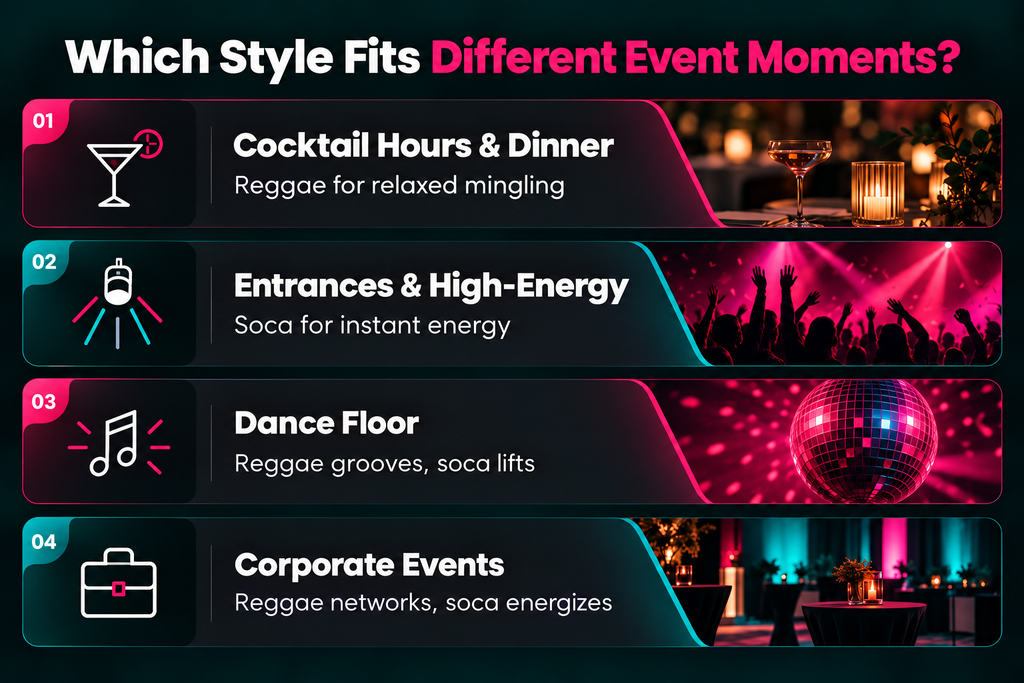
Cocktail Hours and Dinner
For receptions where conversation remains a priority, reggae can provide rhythmic interest without dominating the room.
Lovers rock, mellow roots reggae, and carefully selected instrumental arrangements are worth considering for wedding cocktails, restaurant-style gatherings, or seated dinners. The volume and song selection should allow guests to speak comfortably.
Entrances and High-Energy Moments
Soca can introduce a noticeable change in atmosphere when an event calls for excitement.
Its strong percussion and participatory character suit wedding-party entrances, festival showcases, celebratory announcements, and procession-style entertainment. A DJ can select a recognizable soca track or build anticipation before introducing a more energetic selection.
Dance Floor
Both genres can fill a dance floor, but the musical experience differs.
Reggae works well for guests who enjoy dancing to a steady, bass-led rhythm. Soca can raise the intensity through upbeat choruses and coordinated crowd responses.
A DJ may also incorporate dancehall, which developed separately in Jamaica, to create additional variety between reggae and soca selections. These transitions work best when they respond to the audience’s musical preferences rather than following a fixed sequence.
Corporate Events and Brand Activations
Corporate entertainment needs to reflect the purpose of each programme segment.
Reggae may enhance informal client gatherings, hospitality spaces, and networking receptions. Soca may be better suited to staff celebrations, interactive brand experiences or a featured performance intended to energize the room.
For Live Entertainment for Corporate Events, ONQ Live can help organizers consider the audience, venue, programme and musical style when choosing performers.
Soca vs. Reggae in Toronto: What Works for Local Events?
Toronto’s Caribbean communities have played an important role in the city’s cultural and musical life. The Toronto Caribbean Carnival, which traces its history to 1967, is a major expression of Caribbean culture, bringing music, masquerade and community celebration into the city’s public spaces.
For planners researching soca vs. reggae Toronto entertainment options, the local setting offers opportunities to explore both genres alongside dancehall, calypso and other Caribbean traditions.
A wedding might feature reggae during the reception and soca later in the evening. A cultural event may need a more specific selection reflecting the participating community, while a mixed-audience party could benefit from a DJ who understands several Caribbean styles.
ONQ Live offers Caribbean music in Toronto through DJs, instrumentalists, vocalists and live bands. The appropriate performance format depends on whether the event requires background music, a featured artist or a dance-focused programme.
For a broader understanding of the musical traditions involved, explore our guide to Caribbean music types, including calypso, dancehall, reggae, soca and other genres.
How to Choose Between Reggae and Soca for Your Event
Before booking entertainment, consider these practical questions:
- Audience: Are guests familiar with reggae, soca, or both? Will they primarily socialize, listen, or dance?
- Event timing: Which parts of the programme need background music, and where would a more energetic performance be appropriate?
- Venue: Is there enough room for dancing? Are there sound restrictions, stage limitations, or specific equipment requirements?
- Cultural relevance: Does the event celebrate a particular Caribbean community or tradition that should guide the repertoire?
- Song selection: Are specific artists, popular tracks, traditional favourites, or family-friendly edits required?
Sharing these details with your DJ makes it easier to create a set that reflects the event rather than relying on a generic party playlist.
Can You Use Both Reggae and Soca at the Same Event?
Yes. Reggae and soca can complement one another when they are selected for different parts of an event.
For example, a wedding DJ might open with melodic reggae during cocktails, introduce dancehall and familiar crossover tracks as dancing begins, and bring in soca when guests are ready for a more participatory atmosphere.
The order does not have to follow this example. Some audiences may prefer soca earlier, particularly when the celebration is closely connected to Carnival culture.
An experienced DJ can adjust the selections by observing the crowd, responding to requests and coordinating musical changes with the event schedule. The result is a varied programme that respects each genre’s identity while giving guests different ways to enjoy the music.
Discover Reggae and Soca DJs with ONQ Live
ONQ Live works with professional DJs whose repertoires include Caribbean music, dancehall, reggae, soca and mainstream dance selections.
Here are three performers to consider for your event.

Steph Honey
Steph Honey is a Toronto-based DJ whose repertoire includes reggae, soca, R&B, pop and dance music.
She has performed at Toronto Caribbean Carnival events and opened for soca artist Patrice Roberts. Drawing on her Caribbean heritage, she also created Give Me Soca!, an event series dedicated to celebrating soca music and culture. Her experience makes her particularly relevant for soca-focused celebrations.
DJ Brainboy
DJ Brainboy brings his St. Lucian roots into performances spanning dancehall, reggae, soca, hip-hop and R&B.
Active as a DJ since 2015, he is known for combining older favourites with newer releases and engaging directly with the crowd. His broad repertoire is well suited to Caribbean-themed parties and events featuring several musical styles.
Triple A Sounds
Triple A Sounds, also known as Andre, has more than 15 years of experience performing at corporate galas, brand activations, and private celebrations.
His repertoire includes Caribbean music, Top 40, dance, and remixes, making him an option for events that need a combination of familiar mainstream tracks and Caribbean selections. His ONQ profile does not specifically list soca or reggae, so those requirements should be confirmed before booking.
These DJs contribute to the wider Toronto live music scene, where Caribbean music remains part of the city’s festivals, nightlife, and private entertainment.
Contact ONQ Live to discuss your event date, venue, preferred genres, and the atmosphere you want to create.
Frequently Asked Questions
1. Can a Caribbean DJ mix reggae and soca in the same set?
Yes. A DJ familiar with both styles can incorporate them into one performance, using suitable tracks and transitions to maintain a natural musical flow.
2. How far in advance should I book a soca or reggae DJ for a Toronto event?
For weddings, summer weekends, and dates around major Caribbean celebrations, several months’ notice is advisable. Contact your preferred performer early to confirm availability.
3. Can I request clean versions of reggae or soca songs for a corporate or family event?
Yes. Provide your DJ with any language restrictions and preferred songs beforehand. Clean edits may be available, but individual tracks should be checked in advance.
4. Do reggae and soca require different sound-system setups?
Not necessarily. Both benefit from equipment capable of reproducing bass and percussion clearly. System requirements depend primarily on the venue, audience size, and whether the performance involves a DJ or live musicians.
5. Can a DJ build a set around a specific island or Caribbean community?
Yes, provided the DJ has appropriate knowledge of that community’s music. Share relevant artists, regional styles, and cultural expectations during the planning process.
6. Is soca suitable for a seated dinner event?
It can be, particularly with selected groovy soca tracks played at a comfortable volume. Faster, more participatory selections are generally better reserved for moments when dancing is encouraged.
7. Can I book a reggae or soca artist for a corporate or private event?
Yes. ONQ Live can help you explore Caribbean DJs and performers for weddings, corporate functions, festivals, and private celebrations. Browse the roster to book an artist and discuss your entertainment requirements.