
House music began in clubs, but its pulse now runs through festivals, radio, streaming, fashion shows and private events. Built on a steady four-on-the-floor beat, the genre grew from Chicago’s Black, Latino and LGBTQ+ nightlife communities into Chicago house, acid house, deep house, soulful house, progressive house, Afro house, tech house and related styles.
Along the way, innovative producers, DJs and performers have continually reshaped its sound and expanded its influence. These 20 house music artists highlight the people and creative ideas that have carried house music across generations, scenes and dance floors worldwide.
What Makes a House Music Artist Influential?
Chart success is only one measure of influence. A producer may change the genre with a drum pattern, bass line, sample or studio technique. A DJ can have an equally lasting effect by introducing records, reading a dance floor or creating a club where a new sound can develop.
Longevity matters too. Influential artists build labels, remix other musicians, connect regional scenes and give later producers a new musical language. That legacy remains audible wherever house music in Toronto brings people together, from nightclubs to weddings and business events.
20 Iconic House Music Artists Across the Decades
The following artists show how widely the house sound has travelled.
House Music Pioneers and Early Innovators
1. Frankie Knuckles
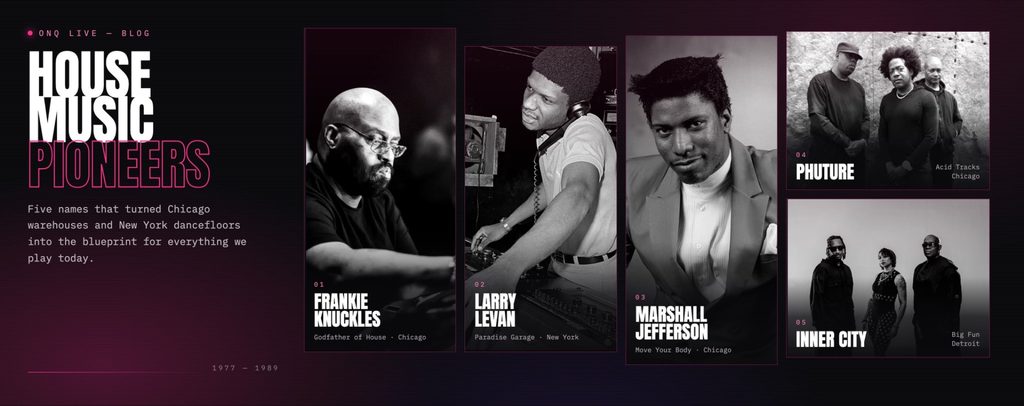
Often called the Godfather of House, Frankie Knuckles helped shape the genre at Chicago’s Warehouse. He extended disco, soul and electronic records with reel-to-reel edits and drum-machine rhythms, then carried that emotional approach into “Your Love” and “The Whistle Song.” His sets joined strong percussion with patient pacing and real feeling.
2. Larry Levan
Larry Levan’s home base was New York’s Paradise Garage, but his influence reaches deep into house music. He used sound, contrast and timing to build an entire night, moving through disco, soul, dub, rock and electronic music while maintaining a dramatic arc. That open-minded technique influenced house music DJs for generations.
3. Marshall Jefferson
Marshall Jefferson helped give early Chicago house an identity beyond stripped-down drum tracks. “Move Your Body,” widely known as “The House Music Anthem,” placed an insistent piano line at its centre and helped make piano house a lasting style. His work joined gospel-influenced vocals and full songs with machine-driven rhythms.
4. Phuture
Phuture, formed by DJ Pierre, Spanky and Herb J, changed dance music with “Acid Tracks.” The group transformed the squelch of the Roland TB-303 bass synthesizer into acid house’s defining voice. A Chicago club experiment became a foundation for scenes in the United Kingdom and Europe, as well as later house and techno.
5. Inner City
Detroit producer Kevin Saunderson and vocalist Paris Grey brought a melodic, vocal-led sound to “Big Fun” and “Good Life.” Inner City connected the precision of Detroit electronic music with the warmth of house, showing that club music could retain its rhythmic character while reaching radio and international audiences.
Artists Who Expanded House Music Globally
6. Todd Terry
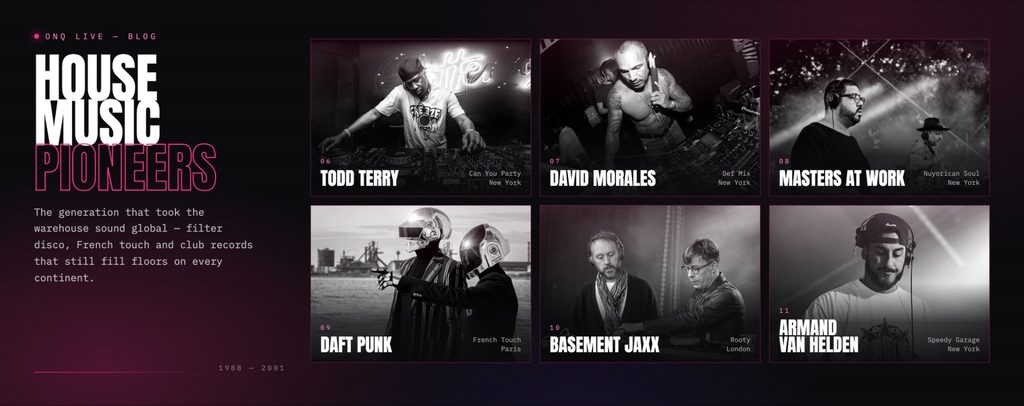
Todd Terry gave New York house a hard, sample-heavy edge. He combined hip-hop-informed sampling, punchy drums and chopped vocal hooks. Records released under his own name and aliases connected American club music with Britain’s rave audience, while his remixes brought house production into mainstream pop.
7. David Morales
David Morales helped establish the remixer as an artist in his own right. His arrangements turned pop and R&B songs into expansive club performances using new percussion, keyboards, bass and vocal dynamics. That polished, soulful approach shaped 1990s dance floors and showed how a remix could fully reinterpret a song.
8. Masters at Work
Louie Vega and Kenny “Dope” Gonzalez combined their rhythmic strengths as Masters at Work. Their productions draw from house, salsa, jazz, funk, hip-hop and Afro-Latin percussion without losing dance-floor drive. Through Nuyorican Soul, they also created a model for live musicianship and club production to work together.
9. Daft Punk
Daft Punk carried French house into global popular culture. On “Homework”, the duo used filters, compression, repetition and samples to create music that was rough-edged and precise. “Discovery” added disco, funk, rock and pop songwriting. Their records, visual identity and large-scale shows changed how electronic artists could present their work.
10. Basement Jaxx
Basement Jaxx made house music colourful and unpredictable. Simon Ratcliffe and Felix Buxton combined club drums with ragga, Latin percussion, funk, punk energy and bold vocals. “Red Alert” and “Where’s Your Head At” brought that approach to a broad audience and treated house as a flexible framework rather than a narrow formula.
11. Armand Van Helden
Armand Van Helden pairs tough drums and bass with recognizable samples. His work moved between house, hip-hop, garage and pop, helping define late-1990s club music’s hook-driven energy. His solo catalogue and later work with Duck Sauce showed how humour, economy and a strong groove could give house lasting crossover appeal.
Modern House Artists and Global Dance-Floor Influencers
12. Kerri Chandler
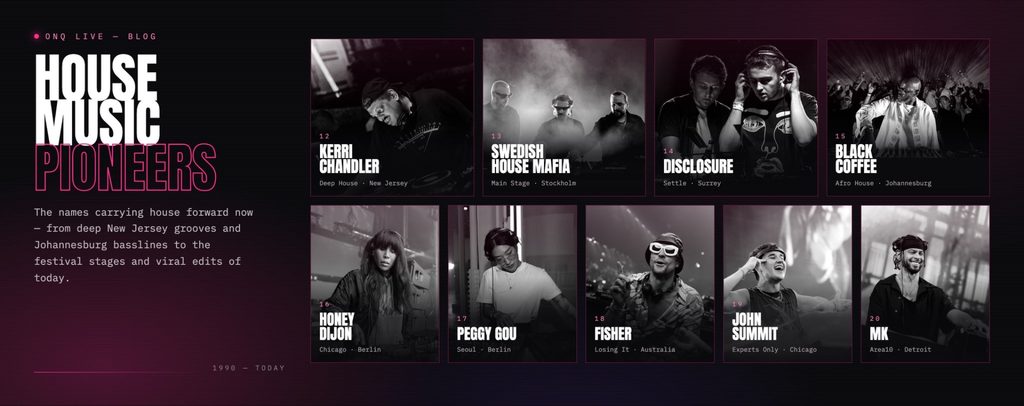
Kerri Chandler’s deep house is never merely subdued. Rich chords, forceful low end and attention to sound-system detail give his productions weight and warmth. Decades of records and technically creative DJ performances have kept New Jersey and New York house principles active for new audiences.
13. Swedish House Mafia
Axwell, Steve Angello and Sebastian Ingrosso helped turn progressive house into arena-scale entertainment. Their builds, vocal hooks and dramatic releases suited very large crowds while remaining rooted in DJ culture. The trio became a reference point for the festival electronic dance music (EDM) boom and collaborative acts presented like bands.
14. Disclosure
Brothers Guy and Howard Lawrence introduced many 2010s listeners to a polished update of house and UK garage. Clipped vocal samples, syncopated percussion and clean bass lines leave space for featured singers. Their work connected club structures with R&B and pop songwriting without losing the rhythmic detail DJs need.
15. Black Coffee
South African DJ and producer Black Coffee brought a spacious, melodic approach to a wider international audience. His restrained percussion, soulful vocals and patient arrangements favour mood over constant peaks. His reach has drawn more ears to South African house traditions and the music often grouped under Afro house.
16. Honey Dijon
Honey Dijon links Chicago house history with contemporary club culture, fashion and visual art. Her sets move through classic house, disco, techno and new underground records while emphasizing the Black and queer communities central to dance music. Her work shows that preserving house history and advancing it can happen together.
17. Peggy Gou
Peggy Gou blends house rhythm, bright synthesizers and understated pop melody. Vocal tracks that include Korean lyrics helped establish her distinct identity within the international club circuit. She represents a global genre in which music, design and fashion can reinforce an artist’s point of view.
18. FISHER
FISHER became a major modern tech house figure through forceful arrangements built around bass, vocal hooks and precise drops. “Losing It” captured the sound’s physical appeal beyond specialist clubs. His sets show how tech house moved from smaller rooms to festivals while retaining a stripped-back rhythmic core.
19. John Summit
John Summit’s rise reflects today’s fast-moving house ecosystem. Club releases, festival sets, streaming and his Experts Only label support one project. His productions move among tech, melodic and progressive house, often combining a clear vocal idea with a driving finish suited to playlists and live crowds.
20. MK
Marc Kinchen, known as MK, connects several eras of house. His early-1990s productions and remixes established a style of chopped vocals, warm chords and garage-influenced drums. Decades later, modern vocal-house releases found a new audience for that approach, showing how a signature sound can evolve without losing its identity.
How House Music Has Evolved Across the Decades
House moved from underground clubs into radio, festivals, streaming, fashion and branded experiences, but not along a single path. Chicago, New York, Detroit, the UK, France and South Africa each changed the music through local tastes and communities.
Modern producers combine four-on-the-floor rhythms with disco, funk, R&B, pop, techno, Afrobeat and Latin influences. Early drum machines, samplers and hardware synthesizers now sit beside laptops, digital DJ systems and live visuals. The tools are more accessible, but selection, timing and musical identity still matter.
The influential DJs across Canada may perform in clubs, on radio, at festivals or for private audiences, with online mixes carrying their work worldwide. Their central responsibility remains the same: understand the room. Successful DJ events in Toronto therefore depend on the artist, schedule, sound system and setting, not a playlist alone.
Discover House Music DJs with ONQ Live
A house DJ can support arrivals, develop energy through dinner and make the closing set the focus of the night.
Our current roster includes professional DJs for weddings, festivals, private celebrations, public programmes, corporate events and brand activations. Three options offer distinct approaches:
- MANZONE & STRONG specialize in tech, progressive, Afro and tribal house, plus EDM. Their four-deck and back-to-back format suits a club-focused performance with sustained momentum.
- LIV DIGITAL blends house with open-format, pop, Top 40 and urban selections. R&B, Motown and disco influences support flexible sets for mixed-age audiences.
- DJ CLYMAXXX combines house and dance with Top 40, urban and radio experience. His genre-blending approach suits galas, luxury activations and celebrations with varied audiences.
For business gatherings, our live entertainment for corporate events can be planned around the venue, programme and audience. DJs can also work with vocalists, saxophonists and percussionists within the wider Toronto’s live music scene.
House Music Keeps Moving Forward
House music is a continuing exchange among DJs, producers, dancers, cities and technologies. These artists show how one rhythmic foundation can support deep, soulful, acid, progressive, Afro and tech house while remaining open to new ideas.
If house music belongs in your next event, speak with ONQ Live about the audience, setting and atmosphere you want to create. We can help identify a DJ and performance format that fit the occasion.
Frequently Asked Questions
1. Who are the most influential house music artists?
Frankie Knuckles, Marshall Jefferson, Phuture, Larry Levan, Masters at Work, Daft Punk and Kerri Chandler are among the most influential. The answer depends on the era, subgenre and whether the focus is production, DJ technique or club culture.
2. Who helped create house music?
House developed collectively in Chicago’s club culture during the late 1970s and early 1980s. Frankie Knuckles is central to that history. Jesse Saunders, Farley “Jackmaster” Funk, Chip E., Marshall Jefferson and Phuture helped turn the emerging sound into records.
3. What is the difference between a house music artist and a house music DJ?
A house music artist usually produces or performs original music. A house DJ selects and mixes recorded tracks for an audience. Many people do both, so the terms often overlap.
4. Who are some of the best house artists from different decades?
Start with Frankie Knuckles and Marshall Jefferson for the 1980s, Masters at Work and Daft Punk for the 1990s, Kerri Chandler and Swedish House Mafia for the 2000s, and Disclosure, Black Coffee or Honey Dijon for recent developments. The best house artists depend on the sound a listener prefers.
5. What are the main types of house music?
Major styles include Chicago, acid, deep, soulful, progressive, tech, Afro, French, piano and electro house. The categories overlap, and artists often move between them.
6. How has house music changed since the 1980s?
House can now be made on a laptop, heard instantly worldwide and performed in venues ranging from small clubs to major festivals. Its four-on-the-floor rhythm, repetition and relationship with the dance floor remain central.
7. Can I book a house music DJ for a corporate or private event?
Yes. You can book an artist for corporate functions, weddings, festivals, private celebrations, brand activations and public events. Share the venue, schedule, audience and preferred house styles so the performance fits the setting.