
A song about a railway, a northern passage or a changing season can reveal as much about Canada as a history book. The most influential Canadian folk music artists have turned landscapes, relationships, working lives and social questions into music that travels far beyond the communities that inspired it.
Canadian folk is not one single sound. It draws from regional storytelling, Francophone and Anglophone songwriting, Indigenous musical traditions, country, rock and contemporary indie music. These traditions developed within distinct cultures and histories, so no individual artist or style can represent the country as a whole.
The ten artists below connect foundational performers with modern voices, revealing how Canadian folk music has grown through storytelling, experimentation and cultural exchange.
What Defines Canadian Folk Music?
Canadian folk music is often recognized by what it pays attention to: place, memory, identity and the experiences of ordinary people.
Its acoustic roots may suggest simplicity, but folk music can carry complex histories. A voice and guitar can tell a family story, document difficult work, preserve a regional experience or challenge the way listeners understand a social issue.
Common characteristics include:
- Narrative songwriting shaped around people, events and places
- Acoustic instruments such as guitar, fiddle, banjo and piano
- Songs about migration, labour, community and belonging
- Personal writing that connects private emotions with shared experiences
- Social, political and environmental commentary
- Movement between folk, country, rock, pop, jazz and indie music
Canada’s folk traditions are culturally and regionally diverse. Music from Quebec, the Maritimes, the Prairies, Ontario, the West Coast and the North reflects different languages, histories and relationships with place. Indigenous music also encompasses many distinct, living traditions that should not be reduced to a single national category.
The Canadian Society for Traditional Music (CSTM/SCTM) describes its field as including the musical traditions of Canada’s many communities as well as their contemporary counterparts. That broad understanding helps explain why folk continues to overlap with so many other music genres.
10 Canadian Folk Music Artists Who Changed the Genre
Together, these artists show how a tradition built on stories and songs can continually find new forms.
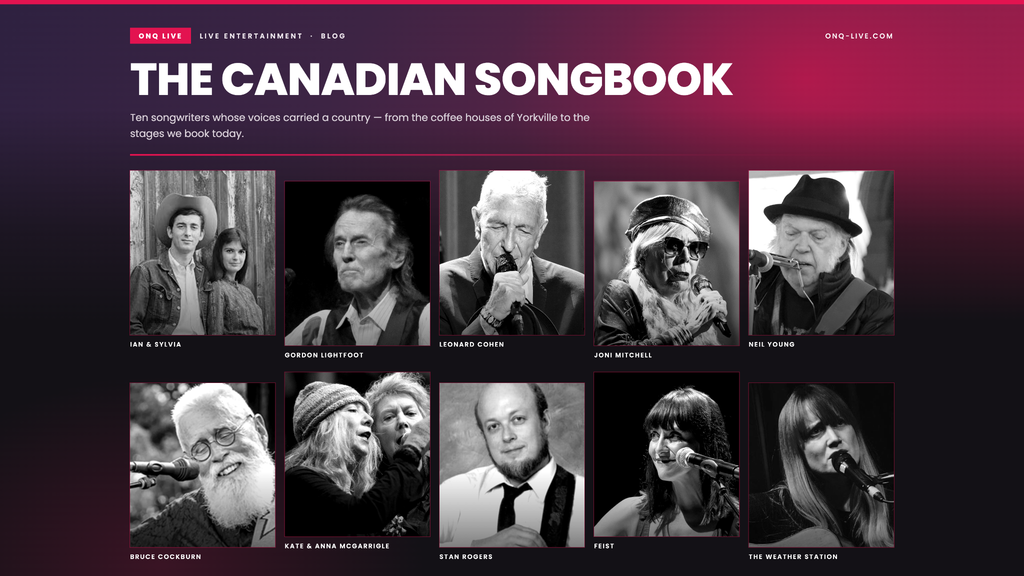
1. Gordon Lightfoot: Canada’s Master Storyteller
Gordon Lightfoot combined clear melodies, a rich voice and precise details to make his songs feel like stories passed from one person to another. “Canadian Railroad Trilogy” turned national history into a sweeping ballad, while “The Wreck of the Edmund Fitzgerald” created a lasting memorial to a Great Lakes tragedy.
Even personal songs such as “Early Morning Rain” carried a strong sense of place. By making railways, lakes and winter landscapes meaningful to listeners far beyond Canada, Lightfoot influenced generations of folk, country and popular songwriters.
2. Joni Mitchell: Expanding the Language of Folk
Joni Mitchell emerged from Canada’s coffee-house folk circuit before moving into increasingly personal and experimental territory. “Both Sides, Now” revealed her ability to reconsider familiar emotions from several perspectives, while “Blue” brought striking intimacy to voice, guitar, piano and dulcimer.
Later albums such as “Court and Spark” and “Hejira” introduced stronger jazz and rock influences. Mitchell’s distinctive tunings allowed her guitar to carry bass, harmony and melody at once, helping her expand the instrument’s role. She showed later songwriters that folk could support emotional honesty, harmonic complexity and constant reinvention.
3. Leonard Cohen: Poetry, Minimalism and Global Influence
Leonard Cohen was an established poet and novelist before releasing “Songs of Leonard Cohen” in 1967. His literary background shaped songs about love, faith, solitude, mortality and human contradiction. “Suzanne” and “Bird on the Wire” paired vivid imagery with restrained acoustic arrangements, leaving space for his measured voice and carefully chosen words.
Although his later recordings incorporated synthesizers, choirs and broader production, Cohen remained connected to the singer-songwriter tradition. His minimalism influenced generations of artists by proving that a quiet voice, a memorable image and an unresolved question could hold an audience.
4. Neil Young: The Bridge Between Folk and Rock
Neil Young moves easily between intimate acoustic songs and electric performances filled with distortion. “Heart of Gold” and “Old Man” reflect his direct singer-songwriter style, while “Ohio,” recorded with Crosby, Stills, Nash & Young, showed how quickly folk-rock could respond to political events. Albums such as “After the Gold Rush” and “Harvest” blended personal writing with country instrumentation and rock dynamics.
His songs have also addressed war, environmental damage and social responsibility. By refusing to remain inside one sound, Young helped shape folk-rock, country-rock, alternative music and generations of independent songwriters.
5. Ian & Sylvia: Voices of Canada’s Folk Revival
Ian Tyson and Sylvia Fricker became defining voices of the 1960s North American folk revival through close harmonies, acoustic arrangements and a mix of original and traditional material. Ian’s “Four Strong Winds” joined geographic movement with emotional separation, while Sylvia’s “You Were on My Mind” reached new audiences through later interpretations. The duo also helped introduce listeners to emerging Canadian writers, including Gordon Lightfoot.
Their later work with Great Speckled Bird moved toward country-rock, creating an important link between folk revival traditions and the roots-oriented bands that followed.
6. Stan Rogers: Regional Stories with National Reach
Stan Rogers used his commanding baritone to tell vivid stories about Maritime communities, family, work and Canada’s demanding landscapes. “Barrett’s Privateers” carried the communal energy of a traditional sea song, despite being an original composition, while “Northwest Passage” connected personal travel with history and northern geography. His characters were shaped by real responsibilities, including fishing, farming and industrial work.
By treating regional lives with specificity and respect, Rogers created songs that became part of a shared Canadian repertoire and influenced later writers documenting their own communities.
7. Bruce Cockburn: Guitar Craft and Social Commentary
Bruce Cockburn combines intricate fingerstyle guitar work with writing about spirituality, politics, human rights and the environment. His music moves across folk, blues, jazz and rock without losing its reflective centre. “Wondering Where the Lions Are” pairs uncertainty with a light rhythmic feel, while “Lovers in a Dangerous Time” and “If a Tree Falls” approach human resilience and environmental responsibility more urgently.
His official biography and discography document a career that has continually crossed acoustic and electric forms. Cockburn influenced artists who use folk music to examine both private experience and wider social questions.
8. Kate & Anna McGarrigle: Harmony, Heritage and Songcraft
Kate and Anna McGarrigle brought Quebec roots, bilingual expression and the intimacy of family music-making into Canadian folk. Their English and French repertoire included “Talk to Me of Mendocino,” “Complainte pour Ste-Catherine” and Anna’s widely interpreted “Heart Like a Wheel.” Close harmonies, piano, accordion and spare arrangements gave their music a sound that could be playful, conversational or quietly heartbreaking.
Their influence continues through harmony-led folk, bilingual songwriting and artists who treat family history and domestic life as meaningful subjects. Their collaborative musical tradition also extended to Rufus and Martha Wainwright.
9. Feist: Intimate Songwriting for a Modern Audience
Feist brought acoustic sensitivity into twenty-first-century indie music through understated vocals, controlled guitar playing and inventive arrangements. “Mushaboom” paired a grounded domestic vision with bright acoustic textures, while “The Reminder” moved between sparse songwriting and rhythmic pop. “Multitudes” later returned to a more communal and immediate performance style.
Feist’s strength lies in her handling of scale: a breath, handclap or muted guitar figure can carry as much weight as a full band. Her work helped bring intimate folk and singer-songwriter sensibilities to audiences shaped by indie rock and alternative pop.
10. The Weather Station: A Contemporary Folk Voice
The Weather Station, led by Toronto songwriter Tamara Lindeman, connects detailed observation with arrangements that extend beyond conventional acoustic folk. “Loyalty” used restrained instrumentation to support intimate character studies, while “Ignorance” introduced percussion, piano, strings and saxophone alongside writing about climate grief and responsibility. “Humanhood” continued that movement toward fluid, ensemble-driven music.
As the project’s official biography reflects, The Weather Station is an evolving songwriting vehicle rather than a fixed formula. Lindeman shows how folk’s narrative and emotional foundations can remain strong inside art-pop and jazz-influenced production.
How These Artists Shaped Canadian Folk Music
The movement from Ian & Sylvia’s revival-era harmonies to The Weather Station’s layered arrangements is not a straight line. It is a continuing exchange between inherited forms and individual voices.
This influence also extends beyond folk, as many famous musicians from Canada have carried Canadian storytelling, experimentation and regional identity into rock, pop and other styles.
These artists changed Canadian folk music in several connected ways:
- Lightfoot and Rogers made regional history and working lives central to widely known songs.
- Mitchell and Cohen expanded the emotional, poetic and harmonic vocabulary of the singer-songwriter.
- Young and Cockburn carried folk into rock without losing its social and narrative focus.
- Kate and Anna McGarrigle connected family, language and Quebec culture through distinctive harmonies.
- Feist and The Weather Station brought folk’s intimacy into indie, pop and experimental arrangements.
The common thread is not one instrument or production style. It is the belief that carefully observed experience can become shared music. Canadian artists repeatedly made local stories meaningful to listeners elsewhere, while widening what a folk song could contain.
Modern Canadian Folk Artists to Explore Next
A new generation is continuing that work without sounding like a copy of the past.

Among today’s modern Canadian folk music artists, William Prince pairs a deep, measured voice with songs about family, faith and Indigenous identity. Basia Bulat brings expressive vocals and instruments such as autoharp into richly arranged indie folk. Leif Vollebekk writes spacious, conversational songs shaped by folk, soul and jazz.
Bahamas, the project of Afie Jurvanen, uses dry guitar tones and relaxed arrangements to explore relationships and self-perception. The Barr Brothers combine folk songwriting with blues, rock and inventive textures, including Brad Barr’s guitar work and Sarah Pagé’s harp.
These performers show why folk remains relevant even as the newest music genres develop around it. The instruments may change, but listeners still respond to a voice that has something honest and carefully considered to say.
Canadian Folk Music in the Live Setting
Folk and acoustic music can create a strong audience connection without requiring a large production. The focus on voice, musicianship and storytelling makes it suitable for settings where guests are prepared to listen as well as socialize.
It can work especially well for:
- Theatres and performing arts programs
- Cultural celebrations and community events
- Outdoor concerts and festivals
- Weddings and private dinners
- Receptions and fundraising events
- Intimate business gatherings
The format is also adaptable. A solo singer-songwriter can suit a small reception, while a duo, trio or full roots band can provide a broader sound for a theatre or festival stage. Thoughtful sound production remains important because lyrical clarity and instrumental detail are central to the experience.
When planning music for corporate events, consider whether guests need unobtrusive acoustic music, a focused concert moment or a more energetic band later in the program. Ensemble size, room acoustics and the expected level of audience attention should all guide the choice.
The same considerations apply when booking festival bands or live entertainment for corporate events. Depending on the atmosphere you want to create, performers such as The Canadiana Band and Canadian country artist Elyse Saunders can bring familiar Canadian sounds to an event while keeping the program varied across eras and styles.
A Canadian Songbook That Keeps Growing
Canada’s folk legacy is not preserved by keeping the music unchanged. It remains alive because artists continue to find new ways to tell stories about place, identity, responsibility and human connection.
From Gordon Lightfoot’s historical narratives to The Weather Station’s expansive contemporary arrangements, these Canadian folk music artists show how a locally rooted song can speak across generations and borders.
Browse our artists to explore performers who can bring thoughtful live music and genuine audience connection to your next event.
Frequently Asked Questions
1. Who are the most famous Canadian folk music artists?
Gordon Lightfoot, Joni Mitchell, Leonard Cohen, Neil Young, Ian & Sylvia, Stan Rogers and Bruce Cockburn are among the most widely recognized. Kate and Anna McGarrigle also made an important contribution through bilingual songwriting and harmony, while Feist and The Weather Station represent more recent developments in Canadian folk and indie music.
2. What makes Canadian folk music distinctive?
Canadian folk music often places strong emphasis on landscape, regional history, migration, work, identity and community memory. Its sound varies considerably across the country, drawing from Anglophone, Francophone, Indigenous and many immigrant traditions. It also moves freely between acoustic folk, country, rock, pop, blues and contemporary indie music.
3. Is Leonard Cohen considered a folk artist?
Yes. Leonard Cohen’s earliest recordings were closely connected to the 1960s folk and singer-songwriter traditions. His acoustic guitar, restrained arrangements and lyric-centred songs fit that context. Although his production later included synthesizers, choirs and other styles, folk remained an important foundation for his approach to songwriting.
4. Which modern Canadian folk music artists should I listen to?
William Prince, Basia Bulat, Leif Vollebekk, Bahamas and The Barr Brothers offer useful starting points. Listeners may also explore The Weather Station’s earlier acoustic work before moving into its more expansive recent albums. Each artist combines folk songwriting with different influences, including indie rock, soul, jazz, blues and contemporary pop.
5. How did Canadian folk music influence rock and pop?
Canadian songwriters helped bring narrative detail, personal reflection and social commentary into rock and pop. Joni Mitchell expanded modern harmony and song structure, Neil Young connected acoustic writing with electric rock, and Leonard Cohen demonstrated the power of lyrical minimalism. Their influence can be heard across alternative, indie, country-rock and contemporary singer-songwriter music.
6. What type of event is best suited to a folk or acoustic performer?
Folk and acoustic performers suit theatres, festivals, cultural programs, weddings, private dinners and intimate corporate events. Solo artists and duos can support conversation during receptions, while trios and full bands can lead a more focused performance. The best format depends on the venue, audience size and desired energy.