
Before a single vow is spoken, before the rings are exchanged, before the tears start, there is a song. The moment those first notes fill the room, every person in that space stops, turns, and feels something.
That is what a wedding processional does. It tells the story of who you are before you’ve said a word.
And in 2026, couples are rethinking what that story sounds like. The era of one-size-fits-all processional music is over. What’s replacing it is something more intentional, more personal and often, considerably more beautiful.
At ONQ Live, we believe your walk down the aisle should feel as unique as your relationship. Here’s how to master the art of the wedding processional in the current wedding landscape.
What’s Actually Trending in 2026
Wedding music is shifting. A few clear patterns have emerged that are reshaping the processional experience.
- Instrumental covers of modern songs are now outperforming the originals. Couples are choosing arrangements, not because they can’t have the original, but because the arrangement often hits harder. A piano cover of a song you both loved in 2019 carries more weight than the Spotify version.
- The “neoclassical and ambient folk” wave is deepening. Think warm cello lines, layered strings, organic textures. Post-Bridgerton, this sound isn’t just popular, it’s emotionally expected by guests who’ve grown accustomed to hearing it in cinematic contexts.
- Couples are choosing sections, not full tracks. A 30 to 60-second window for the wedding party and a separate, distinct section for the bride’s entrance is now the preferred structure. Full-length tracks feel like a playlist; curated moments feel like a ceremony.
- Live music is reclaiming the ceremony. While evening receptions still see DJs and curated playlists, the ceremony itself is increasingly returning to live performance, particularly for the processional. The reasons are practical as much as emotional.
The Three-Phase Structure Every Ceremony Needs
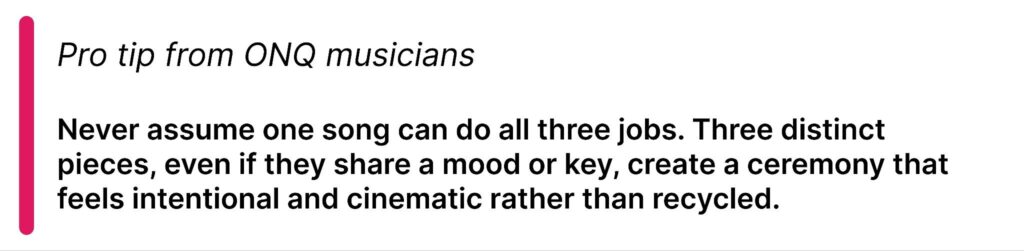
One of the most practical shifts in 2026 processional planning is thinking in three musical phases rather than one continuous track:
Phase 1: The Prelude
Ambient background music as guests arrive and are seated. This is the emotional temperature-setting phase. Choose something soft, such as an acoustic guitar, solo piano, or a string duo, that signals to guests that something significant is about to happen without demanding their attention. Aim for 20-30 minutes of music that fades naturally into the background of conversation.
Phase 2: The Wedding Party Entrance
This should feel welcoming and elegant without peaking too early. The function of the wedding party processional song is to build anticipation. Think of it as the opening act, beautiful, warm, and building toward something. Softer instrumental pieces, acoustic modern covers, or a light classical piece work well here. The pace should be comfortable, not rushed, not funeral-slow.
Phase 3: The Bride’s (or Couple’s) Entrance
This is the emotional center of the ceremony. It should feel unmistakably different from what came before a lift, a shift, a crescendo. Whether you go classic or completely unexpected, this song needs to make the room hold its breath. Choose it first, then work backwards.
Songs Couples are Choosing Right Now
Here’s an honest look at what’s actually being requested at ceremonies in 2025-2026, spanning classic, modern, and unexpected choices:
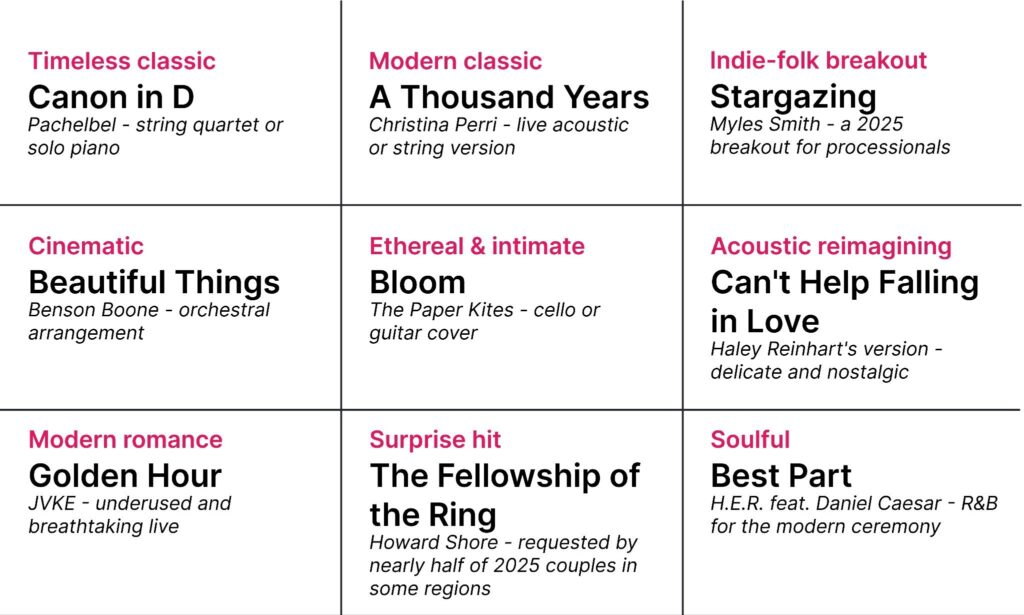
The gold standard for elegance. Whether via string quartet or solo piano, its build-up creates a perfect, natural pace for the aisle.
A romantic powerhouse. Opt for a live acoustic or string version to give this beloved track a fresh, sophisticated breath of life.
The 2025/2026 standout. Its upbeat yet sentimental rhythm is perfect for an outdoor or “boho-luxe” ceremony.
For a high-drama entrance. An orchestral arrangement transforms this chart-topper into a sweeping, emotional masterpiece.
Intimate and delicate. A cello or finger-style guitar cover captures the “whisper-soft” magic of a morning or garden wedding.
Can’t Help Falling in Love Inspired by Haley Reinhart’s version, this nostalgic arrangement is best played live to capture those fragile, spine-tingling vocal or instrumental nuances.
Underused and breathtaking. A solo pianist can mimic the song’s “shimmering” effect, making the room feel like it’s glowing as you walk.
A massive 2025/2026 trend. “The Shire” theme offers a sense of “home” and adventure that resonates deeply with modern couples.
The ultimate R&B processional. Perfect for a live duo, it sets a smooth, cool, and deeply romantic tone for the modern ceremony.
Notice what most of these have in common: they work better live. A string quartet playing “Stargazing,” a pianist drawing out the intro of “Golden Hour” to match the bride’s walking pace, a vocalist gently holding a note longer to time the moment perfectly, this is what separates a ceremony from an event.
Live Music vs. Recorded Tracks: An Honest Comparison
Both options are valid. But they are not equal in what they can do for a processional specifically. Here’s the reality:
Live music
- Adjusts tempo in real time to match the walk
- Responds to emotional cues from the room
- Can extend or shorten sections seamlessly
- Creates a felt presence, sound with warmth and breath
- Elevates the visual experience of the ceremony
- A live musician can follow the officiant’s nod
Recorded tracks
- Consistent sound quality if the system is good
- More budget-friendly
- Simpler logistics for small or outdoor venues
- Huge song selection without arrangement cost
- Requires a reliable sound system and operator
- Cannot adapt if the moment runs long
The single most important advantage of live music at a processional is the flexibility in timing. No song is the exact right length for any given aisle. A live musician can stretch a bridge, repeat a chorus, bring down the volume gently, or hold a note, all while keeping the emotion alive. A recorded track starts, and the clock runs.
Which Instruments Work Best for a Processional?
The instrument matters as much as the song. Different setups carry different emotional signatures:
String Quartet
The gold standard for ceremony music. Rich, layered, and adaptable across classical and modern repertoire. A quartet can move between moods, soft during seating, swell for the bride’s entrance, with a cohesion no playlist can replicate. Works for both formal ballrooms and intimate garden ceremonies.
Solo Pianist or Piano Duo
Deeply intimate. A single pianist performing a Debussy prelude or a contemporary piece like “A Thousand Years” creates an atmosphere of focused, intentional beauty. Piano also pairs perfectly with a vocalist for ceremonies where the processional is sung.
Harpist
Underused, and always stunning. The harp carries a natural softness that works beautifully for prelude and seating music, and a surprising versatility; it handles classical and contemporary arrangements with equal grace. ONQ’s harpists are particularly popular for outdoor summer ceremonies.
Acoustic Duo: Guitar And Vocals
For couples who want warmth and personality over formality. A guitarist and vocalist performing an intimate cover of a meaningful song adds a storytelling quality to the processional that feels deeply personal. This setup is increasingly popular for garden, barn, and bohemian ceremonies.
Saxophonist Or Jazz Ensemble
For the couple who wants something completely their own. A saxophone processional is unexpected, cinematic, and deeply elegant. Jazz ensembles can take familiar songs and transform them into something that feels like a film score: custom, emotional, unrepeatable.
Common Mistakes (And How to Avoid Them)
Even with all the right intentions, a few easily avoidable mistakes can disrupt an otherwise perfect processional:
- Using the same song for the wedding party and the bride’s entrance
The bride’s entrance should feel like a clear emotional shift. Choosing a different song helps create contrast and makes the moment feel more powerful. - Skipping a rehearsal with the musicians
Even experienced musicians need a walkthrough. This is when timing, cue signals, entrance order, and song transitions are confirmed, so nothing feels rushed or improvised on the day. - Choosing music that does not suit the venue
A garden ceremony, hotel ballroom, church, and grand cathedral all carry sound differently. Talk to your musicians about the venue early so they can recommend music that fits the space. - Letting the song play too long
A processional should feel emotional, not stretched out. As a general guide, 60 to 90 seconds works well for the wedding party, while 90 seconds to two minutes is usually enough for the bride’s entrance. - Choosing a song only because it is popular
The best processional music should feel personal to you. Guests may not know what songs are trending in 2026, but they will feel when the music truly belongs to the couple and the moment.
The Last Thing Worth Saying
No one leaves a wedding talking about the canapés. They talk about the moment the doors opened, and the music started, and whether they felt something true in that room.
The processional is not a soundtrack. It is an opening scene, one that sets the emotional register for everything that follows. Choose it with that weight in mind, and let the music do what only music can: make time stop just long enough for the moment to matter.