
Rhythm and blues (R&B) is a powerhouse genre born in the 1940s from the soulful fusion of blues, jazz, and gospel. It has evolved from classic soul and 90s slow jams into a modern sound that blends effortlessly with pop and hip-hop.
Known for its smooth vocals and emotional depth, R&B is the ultimate choice for live events. Whether it’s a romantic wedding ceremony or a high-energy corporate gala, R&B creates a sophisticated, engaging atmosphere. Through ONQ Live, you can connect with premier vocalists and bands who bring this timeless genre to life, tailoring the groove to perfectly match your event’s mood.
What Does R&B Stand For?
The term R&B became widely used in the late 1940s to describe music created by Black artists and marketed to Black audiences in the United States. At the time, the sound was strongly connected to blues, jazz, gospel, boogie, and swing, but it had a stronger beat and a more danceable feel than many older blues recordings.
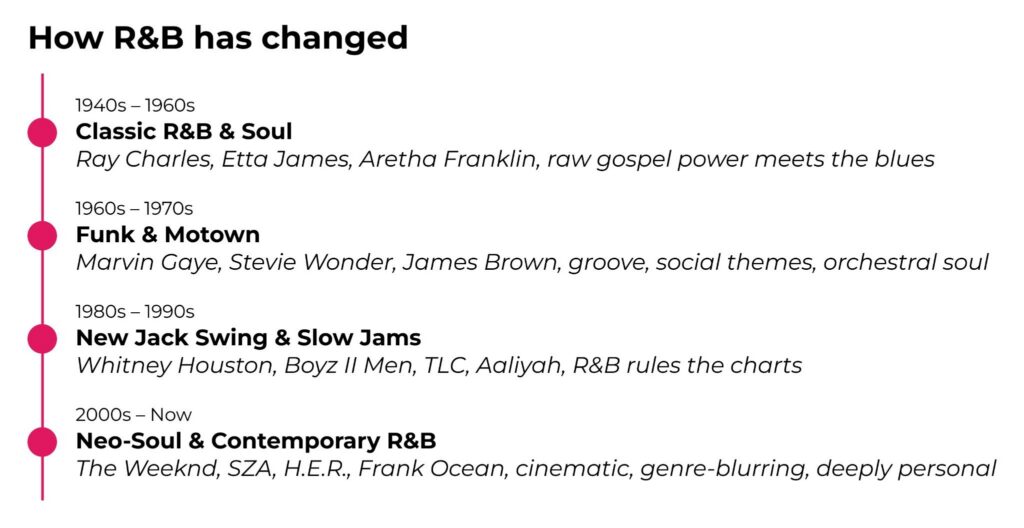
The meaning of R&B has changed over time. In the 1940s and 1950s, it often referred to upbeat, blues-based music with a strong rhythm section. Later, the genre expanded into soul, funk, quiet storm, contemporary R&B, new jack swing, neo-soul, and alternative R&B. Today, R&B can include everything from classic Ray Charles and Aretha Franklin to modern artists like SZA, H.E.R., The Weeknd, Daniel Caesar, and Victoria Monét.
So, to define R&B music simply: it is a genre built on rhythm, emotion, expressive vocals, and strong musical feeling.
The Origins of R&B Music
R&B was born in the urban centers of the United States, rooted deeply in the African American experience. It emerged as a sophisticated cocktail of three primary influences:
- The Blues: Providing emotional depth and storytelling.
- Jazz: Contributing complex horn arrangements and improvisational flair.
- Gospel: Lending the powerful, soaring vocal techniques and “call-and-response” dynamics.
In the 1950s, artists like Louis Jordan and Ruth Brown laid the groundwork, taking the genre from the church and the juke joint to the mainstream airwaves.
How to Define R&B Music Today
In the modern era, R&B is defined by its glossy production and vocal gymnastics. While “Classic R&B” relied heavily on live brass sections and upright basses, “Contemporary R&B” often utilizes sleek electronic beats, synthesizers, and hip-hop-inspired percussion.
Key elements that define R&B across eras:
- Melodic, expressive vocals with an emphasis on feeling
- Groove-based rhythm sections
- Themes of love, relationships, and personal experience
- Strong ties to African American musical and cultural traditions
- A willingness to evolve and absorb new influences
Key Characteristics of the R&B Genre
Vocal Style
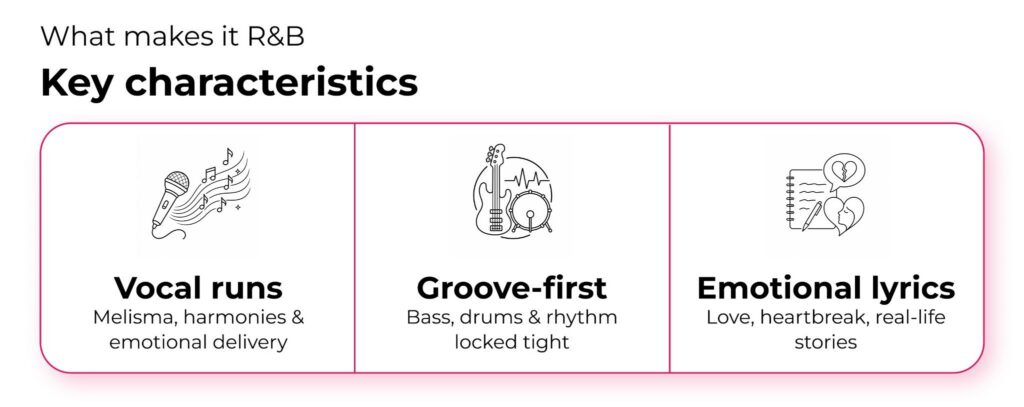
Vocals are one of the most recognizable parts of R&B music. The genre places a strong focus on tone, control, expression, and emotion. R&B singers often use smooth phrasing, vocal runs, harmonies, and dynamic changes to bring the lyrics to life.
Singing the notes correctly is not the main objective. It is to make the listener feel something.
That is why many R&B performances feel personal and intimate, even in a large venue. A strong R&B vocalist can take a simple lyric and make it feel full of meaning through tone, timing, and delivery.
Rhythm and Production
Rhythm is just as important as the vocals. R&B is built around groove.
Classic R&B often uses drums, bass, piano, guitar, saxophone, horns, and organ. The rhythm section creates movement, whether the song is upbeat or slow. Even a soft ballad usually has a clear pulse.
Modern R&B may include electronic drums, bass-heavy production, samples, synths, and atmospheric textures. Carnegie Hall’s timeline notes that by the late 1990s and 2000s, hip-hop and technology became major frameworks for R&B production, helping the genre connect with new audiences.
Lyrics and Themes
R&B has always been the music of human relationships. Love in all its forms, romantic, anguished, joyful, complicated, sits at the heart of most R&B songwriting. But the best R&B goes deeper than simple love songs. It explores jealousy, loss, forgiveness, longing, self-worth, and the messy complexity of being human.
Classic artists like Marvin Gaye and Stevie Wonder also wove social commentary and political awareness into their music, proving that R&B could carry weight beyond romance. Modern artists continue in that tradition, writing about identity, race, mental health, and personal freedom alongside the timeless themes of love.
Popular R&B Songs Everyone Should Know
A complete R&B playlist can include many different eras and moods. Here are examples that show how the sound has evolved:
- “Respect” – Aretha Franklin
- “I Got a Woman” – Ray Charles
- “What’s Going On” – Marvin Gaye
- “Superstition” – Stevie Wonder
- “Ain’t No Sunshine” – Bill Withers
- “End of the Road” – Boyz II Men
- “No Scrubs” – TLC
- “If I Ain’t Got You” – Alicia Keys
- “Confessions Part II” – Usher
- “We Belong Together” – Mariah Carey
- “Adorn” – Miguel
- “Best Part” – Daniel Caesar ft. H.E.R.
- “Good Days” – SZA
- “Blinding Lights” – The Weeknd
- “On My Mama” – Victoria Monét
R&B music has grown across decades, but it continues to focus on rhythm, feeling, memorable vocals, and emotional connection.
R&B Music in Events and Live Performances
R&B creates a relaxed yet sophisticated atmosphere.
- Weddings: From the ceremony to the reception, R&B provides the perfect romantic backdrop.
- Corporate Events: It offers a polished, professional vibe that isn’t distracting but remains engaging.
- Live vs. Recorded: An authentic and energetic live R&B band is preferable to a playlist. A live vocalist can read the room, extending a chorus to build energy or softening a verse to heighten a romantic moment.
ONQ Live specializes in this “bespoke” musical experience. Whether you need the high-energy party vibes ofFamous Players Band or the soulful, intimate sounds ofClaire Davis, our roster is curated for quality.
Tips to Choose the Right R&B Music for Your Event
Selecting the perfect soundtrack requires balancing the mood of the moment with the energy of your guests. Although R&B is quite adaptable, you should fit the particular “flavour” of the genre to the kind of event you’re hosting.
Here is how to choose the right R&B vibe using featured ONQ Live artists:
1. Define the Mood
- Romantic & Intimate: For wedding ceremonies or first dances, look for soulful vocalists or soft keys.
- Sophisticated & Relaxed: You want a “lounge” atmosphere that encourages conversation for cocktail parties or business networking.
- Top Picks: Claire Davis for retro-soul vibes or ONQ Big Sax for a lush, instrumental R&B atmosphere.
- High-Energy Party: For wedding receptions or private parties where dancing is the priority.
- Top Picks: Famous Players Band for chart-topping hits or Wing Night (The Band) for the ultimate 90s R&B throwback.
2. Consider Your Audience
- The Nostalgic Crowd: If your guests grew up in the 90s and 2000s, legendary slow jams and “New Jack Swing” beats are a must. Soul Nostalgic specializes in this exact “golden era” feel.
- The Diverse Crowd: For a mix of ages, go with a group that can pivot from Motown classics to modern SZA or Bruno Mars. St. Royal Entertainment is an expert in reading the audience and fusing different periods.
3. Choose the Right Ensemble Size
- Soloists/Duos: Best for smaller spaces or adding a “live touch” without overpowering the room. Scotch (The Band) offers a tight, professional sound for mid-sized gatherings.
- Full Bands: Necessary for large venues and high-impact energy. Momma’s Kitchen brings that full-bodied, organic R&B/Soul sound that fills a room with warmth and passion.
4. Don’t Forget the “Soul” Factor
Think about the genre’s origins if your event has a profound, joyous, or communal focus. Liam Myrie brings a gospel-infused vocal power that adds a spiritual and emotional depth to any performance.
Common Misconceptions About R&B
- “It’s only for slow dancing.” False! From 70s Funk to 90s New Jack Swing, R&B has some of the highest-energy dance tracks in history.
- “It’s the same as Soul.” While related, R&B is a broader umbrella that includes more rhythmic and commercial elements than traditional Soul.
- “It hasn’t changed.” R&B is one of the most innovative genres, constantly absorbing influences from trap, synth-pop, and electronic music.
R&B music has lasted for generations because it speaks to real human emotion. It can make people dance, reflect, celebrate, remember, or feel deeply connected to a moment. From its roots in African American musical traditions to its influence on pop, hip-hop, soul, funk, and modern music, the R&B genre continues to shape the way people listen, perform, and experience music.
For weddings, private parties, corporate events, and live performances, R&B brings a rare balance of elegance, warmth, and energy. If you want to create an atmosphere that feels personal, stylish, and memorable, exploring live R&B experiences through ONQ Live is a strong place to start. Secure the date today.